
Authors:
Slobodan Tomić | University of York, UK
Branislav Radeljić (Corresponding Author) | Nebrija University, Spain; The Aula Fellowship, Canada
Abstract
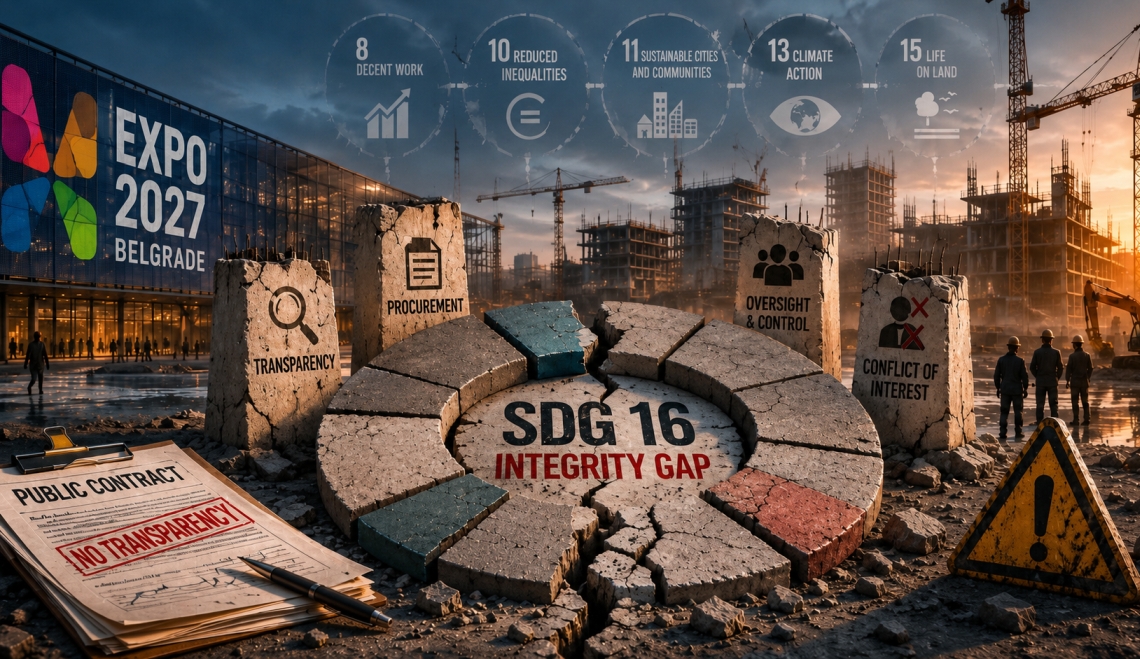
Mega-events are increasingly framed as catalysts for the UN Sustainable Development Goals (SDGs), yet their reliance on vast public investment creates profound ethical risks. This paper examines the governance of Expo 2027 in Belgrade (Serbia), to assess whether SDG-focused narratives reflect genuine commitment or merely symbolic rhetoric. Our analysis finds that the expected integrity framework for the project is fully absent. We argue that this failure substantively undermines SDG 16, for which integrity safeguards—such as fair procurement and transparency—are constituent elements. Even more concerning from the perspective of the SDG agenda, this “integrity vacuum” triggers a cascading event whereby a range of other goals are systematically undermined. Our empirical analysis demonstrates how the lack of safeguards negatively impacts several specific goals, most notably SDG 11 (Sustainable Cities), SDG 13 (Climate Action), and SDG 8 (Decent Work). Overall, the analysis shows how the failure to ensure integrity safeguards leads to a cascading effect throughout mega-event preparation and hosting. This suggests an urgent need for institutional reform—primarily through better-designed monitoring and sanctioning systems for host governments—among global mega-event awarding bodies to protect the ethical legitimacy of the SDG agenda.
Keywords: Expo 2027, corruption, accountability, public spending, Sustainable Development Goals
Access the original paper: https://papers.ssrn.com/sol3/papers.cfm?abstract_id=6757998